Summary: Why Domenico Scarlatti — one of music’s lesser known giants — is such an important composer to me.
Posted Fri, Apr 13, 2018 @ 13:06 : Words: 1604 : Reading time: 8"
Tags:

Domenico Scarlatti
Domenico Scarlatti has been a part of my life ever since I first heard his music as a tween.
Scarlatti, along with GF Handel and JS Bach – all born in 1685 – are considered the giants of the (late) Baroque era. Scarlatti , for understandable reasons, is the least known of the three. Handel and Bach were inveterate self-promoters, were at the musical centres of their respective locales, composed wide varieties of music for many venues, and their music was widely published. (Though it must be said that JS Bach’s reputation wasn’t as great in his time as Telemann’s, and was later eclipsed by his second son, CPE Bach (another of my very favorite composers). It was only later (mid 1800s) that JS Bach’s music was rediscovered by the Romantic composers when he attained his modern reputation.)
Scarlatti, on the other hand, when not gambling (the Queen paid off a lot of his gambling debts), or spending time with his family, was a humble Court servant: he spent the majority of his adult life out of the public eye, having secured a position as one of the court composers (and not even the most renowned one!) at the out-of-the-way, reclusive Spanish Court, mostly in service to the Queen as her personal composer. The vast majority of his music was unpublished in his lifetime, and most of his compositions were written for a single instrument, the harpsichord, that soon went out of favor with the development of the piano.
So it’s not too surprising that Scarlatti wasn’t included in this triumvirate of the Baroque greats until the last century. His music was only gradually discovered many years after his death; and it was only in the last few generations that that his reputation has grown to its current stature.
This isn’t to say Domenico wasn’t completely unknown in his time. He was one of ten children of Alessandro Scarlatti, then the most famous opera composer of his time. Domenico’s father took an active role in introducing Domenico to the musical public. Before he was cloistered in the Portuguese and Spanish courts, he was known in certain circles primarily as a brilliant performer. Queen Barbara (then the Princess of Portugal) discovered Scarlatti on a trip to Italy. (Her Royalness took harpsichord lessons from him, which eventually led to an offer he couldn’t refuse.) Those who heard him perform were unanimous in their praise, and never forgot him; indeed he developed a small but devoted coterie of admirers, much as modern rock bands have worshipful fans before they hit mainstream success. Even Handel became a fan of his after Scarlatti bested him on the harpsichord in a famous impromptu competition between the two of them. (Oh to have been there for that!) It’s these steadfast followers of his who were responsible for promulgating Scarlatti’s name after his death that eventually led to his posthumous (re)discovery.
I first came across his music thanks to Wendy Carlos. Her album Switched-On Bach was enormously popular, a surprising break-out hit. She followed this with another popular album The Well-Tempered Synthesizer, which contained four of Scarlatti’s sonatas. Carlos’s albums came out at the height of the hippie era. She popularized the Moog Synthesizer with her interpretations of some great Baroque tunes, which were no doubt incredible head-music for stoners and trippers. I was too young to experience the music this way, which is not to say that I didn’t get my own kind of pre-teen highs from such music. And thus was Domenico one of the composers who turned me onto music. Though he’s drifted in and out of my attention over the years, he’s always accompanied me. (Indeed I had a beautiful, sweet, affectionate black cat I named Scarlatti. He often slept on my chest. His ashes are in a little urn on my bookshelf. I still miss him...)
Several years ago I finally acquired the complete recordings of his 555 Sonatas performed by the brilliant harpsichordist Scott Ross. Ross was the first musician to perform the complete sonatas. I already had a few dozen on LP, so I was thrilled to finally get them all. This 34 CD release was a milestone in the history of classical music recordings. Ross’s performance of the sonatas combine technical prowess with profound sensitivity, insight, and understanding. These recordings are rightfully considered “remarkable” and “unprecedented” by many classical afficionadoes (myself included, obviously).
So for the past ten years or so I have imbibed these sonatas with great enthusiasm, discovering a wealth of musical gems that continue to amaze me. And gems is right – each piece is a jewel.
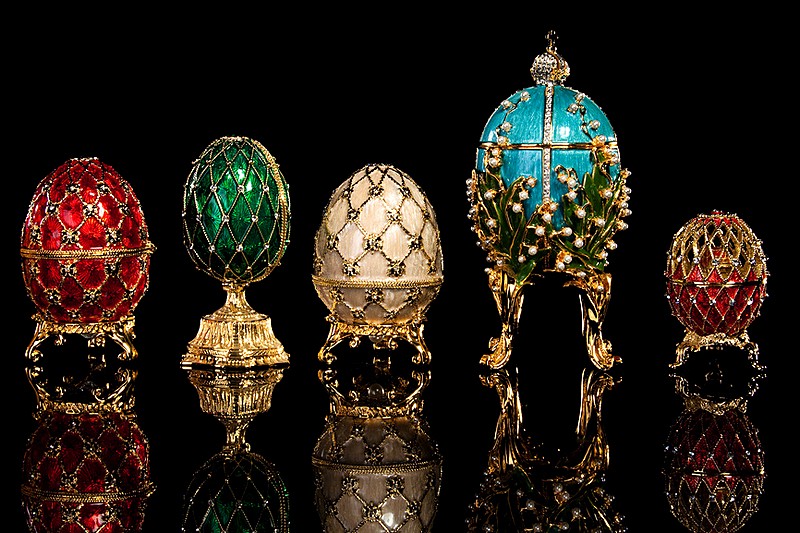
Faberge eggs
In such a large cache of gems a few invaluable diamonds can be found, quite a few more stand out as obviously more polished, rare, and precious than others, but each one sparkles in its own way. Or, to continue flogging the dead horse, instead of building cathedrals (JS Bach), depicting sunrises (Grieg), exploring mythological archetypes (Wagner), disclosing our existential condition (Schnittke), etc., Scarlatti fabricated 555 exquisite Fabergé Eggs.
We have his patron, Queen Barbara of Spain, to thank for this remarkable largesse. She was an accomplished harpsichordist, and, though he fulfilled the many duties required of a court composer, it seems Scarlatti’s most important service was to compose sonatas for her Highness’s personal enjoyment. Without the constraints of having to appeal to public tastes to earn his living, he was free to innovate and explore the potentials of musical expression within his contemporary idiom for a benefactor who couldn’t get enough of them. Plus, he was immersed in the unique Iberian musical soundscape that had rhythms and harmonies not heard elsewhere in Europe. The result is some of the most unique, daring, and astonishingly individual music of its time, perhaps of all time.
Scarlatti is one of those artists who found tremendous creative freedom in rigorous structures. His creative invention with these sonatas is vast; and yet, with few exceptions, his musical experiments are contained within a very tight binary structure. And no matter how wild his experiments get, he never loses control, though it may seem like he has. Scarlatti's music is often more about noise and texture than melody, which is why the Romantics didn't understand his music. He was playing with sonorities, like an early Conlon Nancarrow, or Japanese noise pop band. I don't think it's an exaggeration to claim that Scarlatti was generations ahead of his time!
But to me the thing that makes his compositions so compelling – beyond their other obvious merits – is his extraordinary sense of pattern: his music seems to me almost algorithmic. His compositions somehow make the harpsichord produce a wall of sound full of intersecting, interlocking, cascading patterns. It’s like he’s drafting complex geometrical soundscapes. Listening to Scarlatti creates sensations in me in a way that no other composer does so vividly: sometimes I get a powerful sense of a musical fabric tesselating time itself; other times I feel like I’m listening to some kind of magical, beautiful, musical state machine (eg: K 219). No other composer makes me experience pattern the way he does. That’s why I find Scarlatti’s Sonatas perfect candidates for visualizing as procedural computer animations.
For a little flavor of the range of his creative genius, here’s a tiny sampling of Domenico Scarlatti’s 555 Sonatas.
-
Sonata in D, K 491
One of his most popular pieces, a lovely melody that is stately, elegant, and sweetly touching. You can hear the Iberian influence, where the harpsichord sounds like a Spanish guitar in places. -
Sonata in F, K 317
A good percentage of his sonatas are what I call Machines: a fast ride fueled by an aggressively propulsive rhythm that doesn’t let up, full of little surprises and the occasional daring chord progression. -
Sonata in Eb, K 253
Consider this a piece of head-bangin' hard Baroque rock. The second half of the piece has some extreme power chords that pound a beat to rival anything heard three centuries later. It’s incredible to me the kind of rich, full, fat sound Scarlatti is able to produce from a single harpsichord! -
Sonata in D, K 298
Speaking of Conlon Nancarrow, Scarlatti seems to channel him for what could be considered an astonishing baroque piece for player harpsichord! Or, indeed, in this case, he achieves a sonority with his virtuoso and obsessive repeating of a single note like a piece of Baroque electronic music. -
Sonata in A, K 405
Just a lovely piece. -
Sonata in b, K 409
The first movement is fairly straightfoward, if perhaps a little bit awkward, and maybe even a little bit ugly... but then the second movement... What the hell is going on?! What is Scarlatti thinking?! Well, for one thing, Scarlatti often employs obsessive repetition like a Baroque minimalist. The Romantics were completely baffled by this! -
Sonata in C, K 513
One of Scarlatti’s most precious diamonds, this is deservedly one of his most famous pieces, and quite unique in his oeuvre. It is an achingly beautiful pastoral, played with remarkable sensitivity by Scott Ross. -
Sonata in E, K 531
Another of his most famous pieces, this one is really something special. It’s a deceptively simple algorhythmic Machine, blessed with a melody that veers into some very poignant territory, swerving between joy and tense melancholy with its surprising shifts in mood-color. (It’s amazing what he achieves with simple arpeggios !) -
Sonata in F, K 525
To me this is one of the most astonishing pieces of music ever composed, full of algorhythmic patterns, rockin'-hard power chords, and, at the beginning of the second half, a mind-blowing, incredibly powerful and moving chord progression. (I still get chills every time I hear it.) It is sui generis.
Note: The K numbers are for Ralph Kirkpatrick, musician and scholar, who catalogued the Sonatas. He also wrote the definitive biography of D. Scarlatti, which was a great read. For those who want a beautifully written, more rigorous musicological analysis of his music I highly recommend W. Dean Sutcliffe’s The Keyboard Sonatas of Domenico Scarlatti and Eighteenth Century Musical Style.